Liza Choa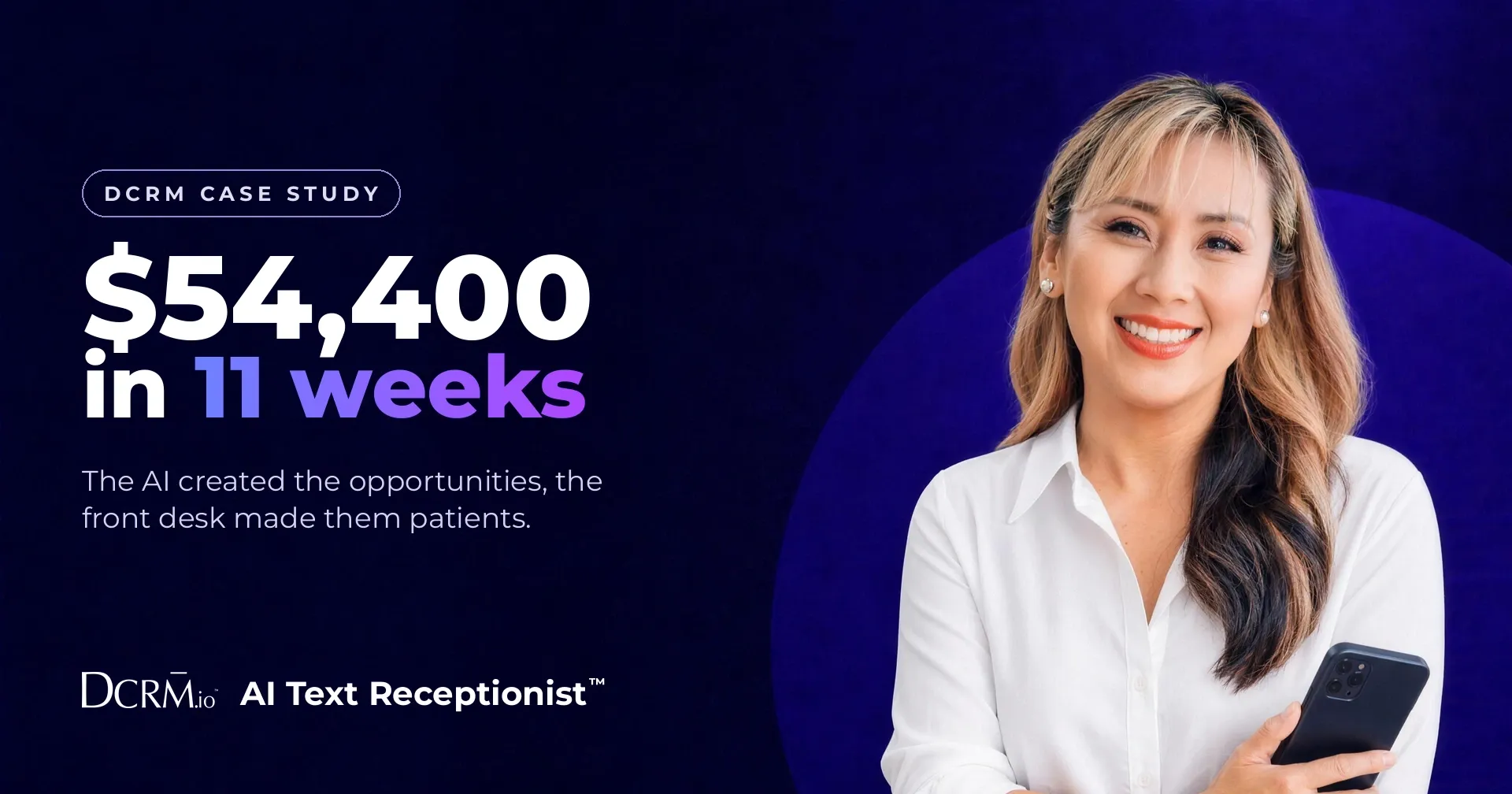
Quick answer
Can a dental AI receptionist book patients without a practice management system integration?
No, and it does not need to. Without an integration it answers the patient’s text, works out which treatment they want, and creates an opportunity for the front desk with a callback time on it. In this practice that produced 47 warm cards and $54,400 of booked treatment in 11 weeks.
A Sydney practice booked $54,400 of treatment in 11 weeks from people who had done nothing more than download a price list. The work was shared between the DCRM AI Text Receptionist, a dental AI receptionist that answers patient texts, and a front desk that rang every person it handed over.
243 people downloaded the price list. A follow-up text went out to all of them asking how they went with it and whether they would like an appointment. 51 wrote back. The AI picked up 48 of those 51 conversations.
AND… it did not book a single one of them.
That was never its job. The practice management system was not integrated with DCRM, so the AI could not touch the calendar. Instead it did what it was built to do. It followed our AAA formula, worked out what the person actually wanted, and got them to say yes to a call. Then it created an opportunity in the SmileEngine pipeline for the front desk to book the patient in! 47 cards landed that way, each with the treatment and a callback time on it. The front desk rang those people and booked them in.
$54,400 is the number everyone looks at. It is not the interesting one, so let me show you what actually happened.
What happened in 11 weeks
| Step | Who did it | Count |
|---|---|---|
| Price list sent, follow-up text sent | DCRM automation | 243 |
| Patient wrote back | The patient | 51 |
| Conversation answered and qualified | AI Text Receptionist | 48 |
| Opportunity created with treatment and callback time | AI Text Receptionist | 47 |
| Patient rung and booked in | The front desk | $54,400 booked |
In plain English: about 1 in 5 people who took the price list wrote back. Almost every one of those replies became a card on the pipeline, with a treatment written on it. Nobody at the practice typed a word until the phone call.
Now… the money is not the part I keep going back to. It is when those conversations happened. Replies landed at 8pm, at 11:40pm and at 5 past midnight. Every one was answered inside 40 seconds, with nobody at the practice.
Think about your own practice for a moment. Before this, that patient got an answer at 8:30 the next morning. By then they had rung somebody else.
How it actually works
Here is how I explain it. Imagine a patient standing at your front desk with a price list in their hand, asking you a question, and every person behind your desk is on the phone.
That is what a text reply is. The AI is the one who turns around straight away and says let me find out for you, would you like our team to call you about a booking. Then it goes and gets somebody who can.
The sequence is 5 steps.
- Somebody downloads your price list. DCRM texts it to them.
- A follow-up text goes out asking how they went with it.
- They reply. The AI picks it up inside 40 seconds, 24×7.
- It chats, works out which treatment they want and whether they want a call, then creates the opportunity with the treatment and the preferred time on the card.
- Your front desk rings that person and books them in.
Why it works
Speed is the whole thing. Somebody who has just downloaded your price list is comparing you with 2 or 3 other practices that evening. Whoever answers first gets the conversation.
But answering first is not the same as booking. A patient deciding on $10,000 of cosmetic work wants a person on the phone, and they should have one. For me, that is not a limitation. That is the design.
The AI and the automation are there to cover off speed. Your team is there for the relationship and to build the trust. They complement each other.
This case study is those 3 sentences with numbers on them. The AI held 48 conversations your team was never going to hold at 11:40pm. It handed the front desk 47 warm cards with the treatment already written down. Your front desk did the part only a person can do, and for me that is the right split.
It is designed by dental marketers with over 15 years’ experience and over 20 years in sales, who understand how patients buy. Not by developers.
The question everybody asks me first
“Will patients know it’s a bot?”
Some will.
And I think it matters less than you would expect, because the AI is not pretending to be your front desk and it is not trying to close anybody. It answers, it asks you 1 or 2 sensible questions, and it says someone will call you. Then someone calls them.
What I see patients react badly to is silence, not software.
What most dental CRMs cannot do
This is the gap I see most often. Most dental CRMs will send your follow-up text. That is the easy half. Most tools stop at the first step.
What a dental AI receptionist does is answer the reply and turn it into something your front desk can act on. Without one, your text goes out, your patient writes back, and the reply sits in an inbox until somebody opens it. You have automated the asking and left the answering to a person who is already on your phones.
When this is not useful for you
I talk to practice owners who are not comfortable with AI talking to their patients at all. If that is you, then you don’t need this, and that is completely ok.
Your price list is the other one. This whole funnel starts with publishing what you charge, and some practice owners would rather not. That is ok too. If your prices are not going on your website, there is nothing to send and nothing for the AI to answer.
And it only works if somebody rings the cards. This practice got its $54,400 because the front desk worked that list every morning. If the cards are going to sit there, invest the money somewhere else. I would rather tell you that now than have you switch it on and wonder why nothing changed.
Here is the thing though. Your patients are already texting practices at 11 o’clock at night and expecting an answer. The practices getting the benefit are the ones who decided early to be in that conversation. The ones still deciding are the ones whose enquiries sit until the next morning.
Where it makes sense is a practice that is happy to publish its prices, happy for AI to take the first message, and has a front desk that will work a callback list.
How to switch it on
- We build your price list funnel in DCRM and connect it to your website.
- We train your dental AI receptionist on your treatments and your tone.
- Your front desk works the opportunities it creates.
That’s pretty much all you have to do on your end.
Frequently asked questions
What does a dental AI receptionist actually do?
It answers patient texts the moment they arrive, works out which treatment the patient wants and whether they would like a call, then creates an opportunity for the front desk with those details on it.
Does a dental AI receptionist book the appointment itself?
Not without an integration into the practice management system. It qualifies the enquiry and hands it over, and a person at the practice makes the call and books the patient in.
How quickly does it answer a patient text?
In this practice, between 18 and 40 seconds, at any hour, including weekends and the middle of the night.
Does the AI quote prices to patients?
No. It points people to the price list and hands anything specific to the team. That keeps you on the right side of AHPRA and stops patients being quoted a number nobody at the practice has agreed to.
What happens to a patient who replies stop?
They come out of the sequence straight away.
What does the front desk have to do?
Keep an eye on the pipeline and ring the people the AI has lined up, with the treatment and the preferred time already on the card. That call is where the booking happens.

Written by
Liza Choa
Liza Choa is the founder of DCRM and Practice Growth Studio, a boutique dental marketing agency working behind the scenes with some of the most respected dental practices in Australia. She has spent over a decade helping practices grow and scale.
She built DCRM after seeing the same problem in practice after practice. The enquiries were already there, but the new patient numbers did not reflect it. DCRM bridges that gap, so practices increase the return on the marketing they are already paying for.
Disclaimer: The figures in this case study reflect the results of one dental practice over a defined period, and were taken from that practice’s DCRM account at the date stated. The practice is not identified, and identifying details have been removed or generalised. Results vary between practices and depend on factors outside the platform, including enquiry volume, treatment mix, pricing, location, team capacity and how consistently the practice follows up. These figures are not a prediction, projection or guarantee of the results any other practice will achieve. Data is reported as recorded in the platform and has not been independently audited. No patient information is disclosed.